 Ficorpio
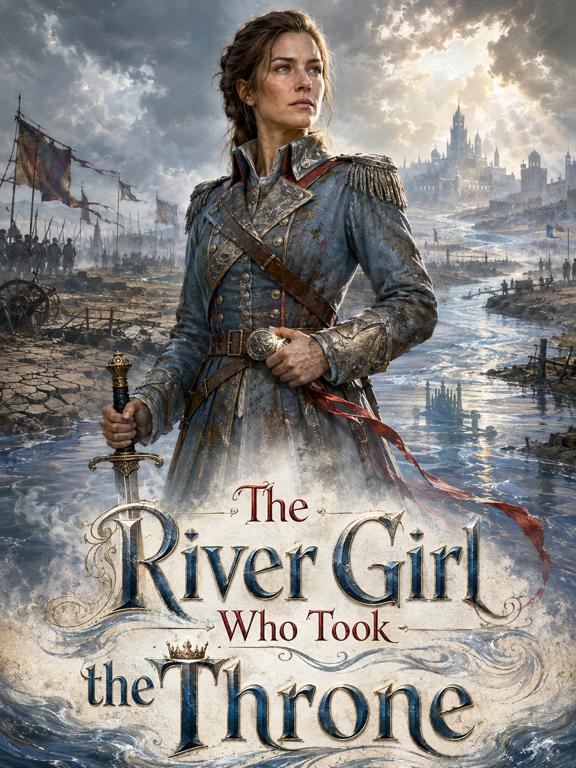
Chapter 1
When I was eight, a lame fortune-teller came to our village.
My mother took pity on him and poured him a cup of water.
He declared that among the three Bennett children, one would become the highest authority in the land, one would become a queen, and one would end up selling herself at a brothel door.
My elder brother had been studying since he was little. Naturally, he would become the ruler.
My younger sister was beautiful. Naturally, she would become a queen.
Which meant the one destined to sell herself had to be me.
Mother handed me a basin of clothes, and I carried it down to the river to wash. My little sister followed close behind.
Our faces appeared side by side in the water.
Her face was small, pale, and clean. She had large eyes, curved brows, and lips that always tilted slightly upward, as though she were forever on the verge of smiling.
My face was broad, rough, dark, and ruddy. My brows were thick, and my eyes were so large and empty that they made me look fierce. The corners of my mouth drooped, as if I were angry all the time.
I smiled at my reflection.
Ha. I really was ugly.
And someone like me was supposed to sell smiles at a brothel door?
I didn’t understand what the fortune-teller’s words meant then. But from the way the adults looked at me, I could tell, vaguely, that it wasn’t anything good.
At dinner, Mother repeated Elias Mercer’s prophecy to Father.
After that, Father valued my brother even more. He didn’t believe in becoming the highest authority in the land or having a daughter become queen. He believed only that his one and only son would pass the examinations, earn an official position, and let him spend the rest of his life as a respected old gentleman.
The only scraps of meat with even a trace of grease on them went into my brother’s bowl.
My sister swallowed hard, staring at them hungrily.
I didn’t even dare swallow.
When everyone had eaten their fill, I took my brother’s bowl outside to wash it. I used the last bit of wild greens and bran to wipe the inside clean, then put the mixture into my mouth and chewed it slowly.
So that was what meat tasted like.
The truth was, my mother and father never treated me badly. They never beat me or cursed me.
Our family was simply too poor.
Only one child could study. Only one child could eat meat. Only one child could be spared from work.
That child wasn’t me.
And to support that child, I would never be allowed to study, never be allowed to eat meat, and never be allowed to stop working.
When I was fourteen, Victor Ashford, the Prince of Zhennan, rebelled in the south.
His war banners spread across the horizon, and his army advanced like a breaking flood. Before long, they had reached the banks of the Lian River.
Every trade collapsed.
Squads of soldiers swept through the villages like combs through hair, taking everything they could carry: grain, coins, and every able-bodied man.
Chapter 2
Father hid Daniel in the root cellar. He was taken in Daniel’s place.
Our family lost one pair of working hands, and with him went our last hope of finding food. Life grew harder by the day.
Mother fell ill. She lay on the bed while Lily, only ten years old, crouched beside her and cried.
And my eighteen-year-old brother? He was a grown man, but no different from a child.
He could read. He could write. He couldn’t lift a hoe or cook a meal.
He paced impatiently, sighing as though the hardship were a personal insult, a crumpled book clutched in his hand.
I knew we couldn’t count on him.
Another two months passed. The Prince of Zhennan’s army still hadn’t crossed the Lian River.
But the village had already consumed its last weeds and strips of bark.
Mother and Lily were reduced to skin and bone. Daniel no longer had the strength to walk.
The four of us lay together on the bed beneath a roof of dry, yellowing straw.
From starvation, Lily’s belly had begun to swell. Her entire body was bloated, like a ball stretched so thin it might burst at the slightest touch.
Half asleep, I felt an itch crawl across my face. When I opened my eyes, I saw a dark beetle making its way over my cheek.
Daniel snatched it up and swallowed it without hesitation.
I stared at him, stunned. Then fear took hold.
Hunger had driven him mad.
He was a man four years older than me, more than a head taller and far stronger. If we let him starve much longer, the day would come when he sold one of us—or ate one of us.
I would have no way to stop him.
That night, I took Lily to the river.
It was a shallow, clear stream. When we were younger, seven or eight children from the village used to play there together.
Now, some had been seized for the army and vanished without a trace.
Others had been married off to distant places—or sold somewhere far away. They had vanished, too.
By some cruel twist of fate, this age of war had given women and men the same destiny: leaving home, traveling far, being scattered, and dying.
Lily and I sat beside the stream. I used the water to wash her hair. Hunger had turned it dry and yellow, and beneath my fingers it felt like a handful of dead straw.
My tears fell onto her face.
She leaned close to my ear and whispered, “Sister, I smell meat.”
I nearly laughed. Hunger must have made her delirious. She was always saying the strangest things.
Then a warm breeze swept across my face.
There really was a smell of meat.
I froze. A thought suddenly struck me.
Lily and I ran back toward home.
Chapter 3
The door slammed open. Mother lay on the bed, and Daniel sat at the table. Everything looked just as it had before.
I let out a breath and began sucking in air, hard and fast. The smell of meat rushed into my chest with even greater force.
It was meat. I hadn’t imagined it.
Everyone could smell it.
In a daze, we followed the scent like marionettes on strings, like puppets pulled along by invisible hands, like starving donkeys chasing a carrot.
After we had gone thirty, forty, perhaps fifty yards, dozens of people had already gathered in the street.
We pushed open a door.
A pot had been set up in the courtyard.
A tiny arm protruded from the boiling water, pale and plump, like a section of lotus root.
I turned aside and vomited.
That night, I thought Daniel’s eyes were shining.
Anyone raised in the wilderness would recognize it. When a torch was held up, a wolf’s eyes looked exactly the same.
I pulled Lily tighter against my chest.
The next day, I went into town alone and sought out Silas Crowe, the human broker. I intended to sell myself.
I didn’t care who bought me. I only cared about getting the highest price.
He found me a hunter’s family living in the mountains. I agreed.
What was a life worth?
They said the Prince of Zhennan had rebelled because his son had died in the capital.
The life of the prince’s heir was worth a hundred thousand soldiers, countless treasures of gold and jade, and the lives of thousands upon thousands of common people.
And what was mine worth?
A single string of coins. Twenty pounds of grain. One piece of candy I had begged for as an extra.
I carried everything home. I gave the money and grain to my mother, Margaret, and the least-patched dress to Lily.
Lily seemed to understand that once I left, we might never see each other again. She clung to me and refused to let go.
“Claire… Claire… don’t go…”
I pushed the piece of candy into her mouth.
She froze.
I took her little hand in mine. “Lily, remember this taste. This is called sweetness. Remember it. Life is only worth living if you can stay alive long enough to taste something sweet.”
Yes. Our names were Claire and Lily.
There were more than a dozen girls in the village called Claire, and more than a dozen called Lily.
Women didn’t need names. They only needed designations.
But my brother did.
Daniel Bennett stood in the doorway. That scholarly face of his finally showed the faintest trace of shame.
I followed Silas Crowe north, putting more and more distance between myself and Lianjiang. It seemed like the safer choice.
After ten days or so, the soles of my shoes wore through. Every step sent pain shooting through my feet, but I didn’t dare ask to stop.